Spiral Flash Dryer for starch drying
Advanced drying technology for native and modified starches

Advanced drying technology for native and modified starches
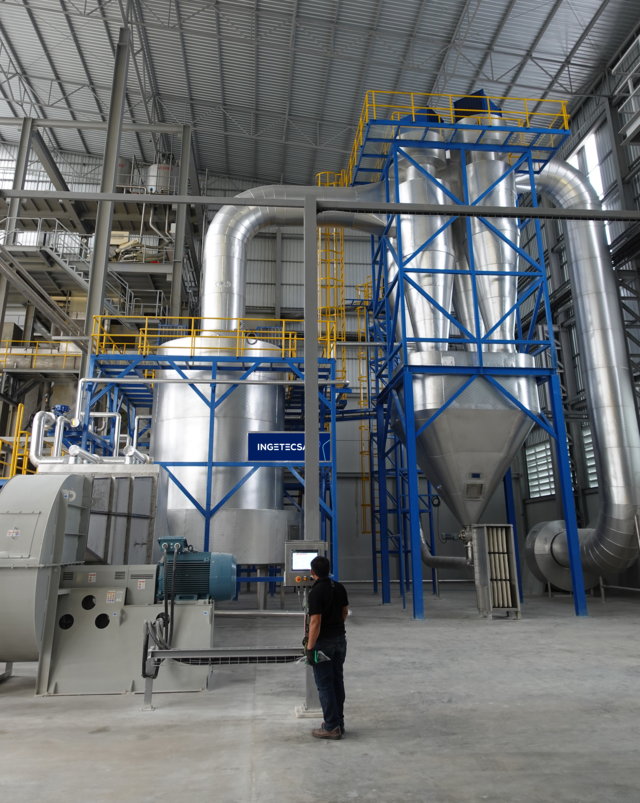
Ingetecsa’s Spiral Flash Dryer (SFD) is designed for the continuous drying of native and modified starches, including potato, wheat, maize, rice and tapioca starch.
Unlike conventional flash dryers, the SFD uses a highly turbulent spiral airflow to disperse and dry the starch without mechanical disintegration inside the drying chamber.
This innovative, static design combines excellent product quality with hygienic operation, low maintenance requirements and a compact installation.
With decades of experience and numerous starch drying references worldwide, Ingetecsa provides proven drying solutions tailored to each application’s capacity, moisture and product quality requirements.
Ingetecsa’s Spiral Flash Dryer is suitable for drying native and modified starches from a wide range of botanical sources, including:
≡ Maize (corn) starch
≡ Tapioca (cassava) starch
≡ Rice starch
≡ Potato starch
≡ Wheat starch
≡ Other native and modified starches
Although starches differ in their physical properties and processing requirements, the Spiral Flash Dryer operates on the same drying principle.
Each installation is designed to meet the specific process requirements, including production capacity, initial and final moisture content, available heating medium and product quality specifications.
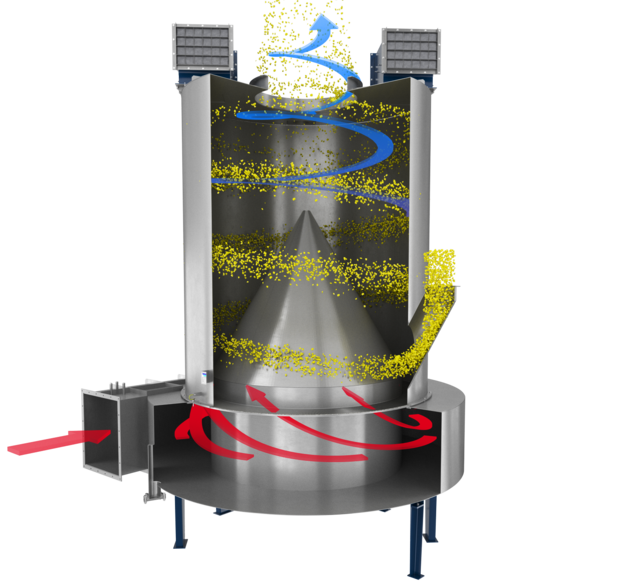
Following mechanical dewatering, wet starch cake is continuously fed into the bottom section of the Spiral Flash Dryer (SFD).
Heated drying air enters through a specially designed static blade ring, generating a highly turbulent spiral airflow. This airflow disperses the wet starch cake into individual particles without the need for a mechanical disintegrator.
As the starch particles travel upwards through the drying chamber, moisture evaporates rapidly. The intensive contact between the particles and the drying air enables efficient drying while maintaining low product temperatures.
The dried starch is subsequently separated from the exhaust air using cyclones or a baghouse filter.
Key advantages of the Spiral Flash Dryer
Superior product quality

More intensive air-to-particle contact promotes sustained moisture evaporation throughout the drying process, resulting in lower product temperatures. This helps preserve the functional properties of starch. Under comparable operating conditions, product discharge temperatures can be 2–3°C lower than with conventional flash drying.
Thorough cleaning and batch changeovers
Spiral Flash Dryers are equipped with access to the drying chamber, allowing thorough inspection and manual cleaning of the entire chamber. This is particularly valuable when switching between different starch products or preparing for batches with stringent cross-contamination requirements. Unlike conventional flash dryers, where the long drying pipe cannot readily be accessed and manually cleaned along its entire length, the compact Spiral Flash Dryer allows the drying chamber to be thoroughly cleaned before production resumes.
Enhanced operational safety
The absence of a mechanical disintegrator eliminates a potential ignition source associated with mechanical friction, jamming or contact between moving parts. This reduces the risk of spark generation and ignition of combustible starch dust, contributing to safer dryer operation.
Hygienic design
The static blade arrangement disperses wet starch without a mechanical disintegrator. With no moving parts inside the drying chamber, the design reduces potential areas for product accumulation and simplifies cleaning.
Compact installation
The spiral airflow provides intensive drying within a compact, self-supporting chamber, eliminating the need for the long vertical drying pipe typically associated with conventional flash dryers.
Low maintenance and high availability
Eliminating the mechanical disintegrator and its associated drive components reduces mechanical wear and maintenance requirements, supporting reliable continuous operation.
Considering a new starch drying installation?
Contact Ingetecsa to discuss your drying requirements and discover how our Spiral Flash Dryer can benefit your process.
Each Spiral Flash Dryer is engineered to meet the specific requirements of the starch product and production process. Although the drying principle remains the same, the equipment design and operating conditions are adapted to the application.
Key design parameters include:
≡ Production capacity: Required throughput, based on wet feed or dried product.
≡ Feed moisture content: Initial moisture content and consistency of the starch cake following mechanical dewatering.
≡ Final moisture content: Target residual moisture and acceptable variation in the finished product.
≡ Product characteristics: Particle size, bulk density, thermal sensitivity and functional properties of the starch.
≡ Heating system: Selection of direct or indirect air heating, depending on the available energy sources and process requirements.
≡ Downstream processing: Requirements for product separation, cooling and storage.
Ingetecsa evaluates these parameters to determine the appropriate dryer configuration and operating conditions, ensuring reliable drying performance while maintaining the required product quality.
Ingetecsa offers complementary technologies to further optimise starch drying installations, from product cooling and conveying to energy recovery.
Following drying, starch often requires cooling before storage, packaging or further processing.
Ingetecsa’s Flash Cooler combines product cooling and pneumatic conveying in a continuous process. The dried starch is brought into contact with cooling air, reducing its temperature while transporting it towards downstream equipment.
The Flash Cooler can be integrated directly downstream of either a conventional Flash Dryer or a Spiral Flash Dryer.
Steam-heated starch drying installations offer opportunities for significant reductions in steam consumption through condensate heat recovery.
By flashing hot condensate and subsequently recovering additional heat as the remaining condensate is cooled, incoming drying air can be preheated before entering the main air heater.
This can reduce steam consumption by up to 28%, depending on the operating conditions and system configuration.
The concept can be applied to both conventional Flash Dryers and Spiral Flash Dryers.
Discuss your starch drying project
Planning a new starch drying installation, increasing production capacity or replacing an existing dryer? Ingetecsa can help you evaluate the most suitable drying solution based on your product characteristics, capacity requirements and quality specifications.