Select your language
Select your language


Industrial drying and cooling technologies for sugar crystals and sugar beet pulp

With 60 years of experience in industrial thermal processing, Ingetecsa builds on a technological heritage in sugar drying and cooling spanning more than a century.
From the early rotary drum dryers for sugar beet pulp to advanced drying and cooling systems for sugar crystals, our technology has continuously evolved to meet the changing requirements of the sugar industry.
Today, Ingetecsa designs and supplies industrial drying and cooling systems for both cane and beet sugar production, focusing on crystal quality, energy efficiency and operational reliability.

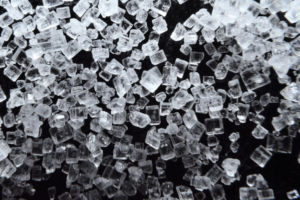
Close-up of sugar crystals
Sugar is produced from either sugar cane or sugar beet. Although the extraction methods differ, the subsequent purification, crystallisation and centrifugation stages follow similar principles.
After centrifugation, the sugar crystals require controlled drying and cooling before packaging, storage and transport. Both thermal processing stages play a critical role in determining the appearance, quality and flowability of the final product.
The main objectives during sugar drying and cooling are:
Preventing water occlusion within the sugar crystals.
Achieving high crystal brilliance and a shiny appearance.
Minimising mechanical damage to the crystal edges.
Ensuring good flowability and storage stability.
The selection and combination of drying and cooling technologies are therefore essential to achieving the required final crystal quality.
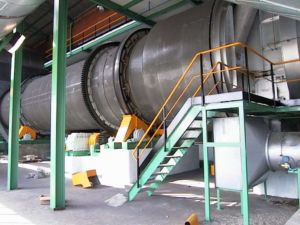
The counter-current Rotary Drum Dryer is the preferred drying technology for sugar crystals. Counter-current operation provides controlled evaporation conditions, helping to prevent water occlusion within the crystals.
Inside the dryer, moisture is gradually removed while the residual syrup adhering to the crystal surface continues to crystallise. This process requires sufficient residence time and carefully controlled drying conditions to achieve the desired crystal quality.
The final stage of crystallisation takes place in the subsequent cooler.
The Rotary Drum Dryer combines several operational and process advantages:
Robust and reliable operation.
Low tendency for product build-up.
Efficient use of thermal energy.
Flexibility in handling variations in feed conditions.
Availability in stainless steel construction.
Read more about our Rotary Drum Dryer.
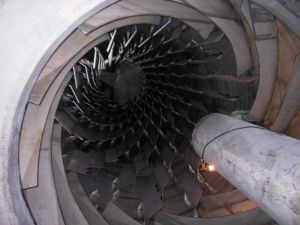
Feed point of moist sugar crystals entering the dryer
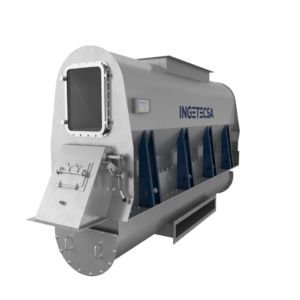
Static fluidised bed cooling for gentle treatment of sugar crystals
Traditionally, sugar crystals were cooled in a counter-current Rotary Drum Cooler following the drying stage. Although this technology provides controlled cooling conditions, the mechanical impact within the rotating drum can damage the crystal edges.
As the sugar industry introduced increasingly stringent requirements for crystal quality, Ingetecsa worked closely with sugar manufacturers to develop an alternative cooling solution based on static fluidised bed technology.
The Static Fluidised Bed Cooler provides gentle and controlled cooling while allowing the final stage of crystallisation to take place.
Compared with rotary drum cooling, this technology offers several advantages:
Reduced mechanical damage to the crystals.
Improved crystal brilliance and shiny appearance.
Gentle polishing of the crystal surfaces.
Simultaneous separation of fines.
The result is a high-quality sugar crystal with improved visual appearance and minimal crystal degradation.
The combination of a counter-current Rotary Drum Dryer and a Static Fluidised Bed Cooler brings together the advantages of both technologies in an integrated sugar processing system.
While the dryer provides controlled moisture removal and further crystallisation of the residual syrup, the cooler completes the crystallisation process under gentle and controlled cooling conditions.
Both processing stages are designed to complement each other, taking into account the incoming sugar characteristics, production capacity, required final moisture content and product temperature.
This integrated approach enables Ingetecsa to optimise the overall process with particular attention to crystal quality, energy efficiency and operational reliability.
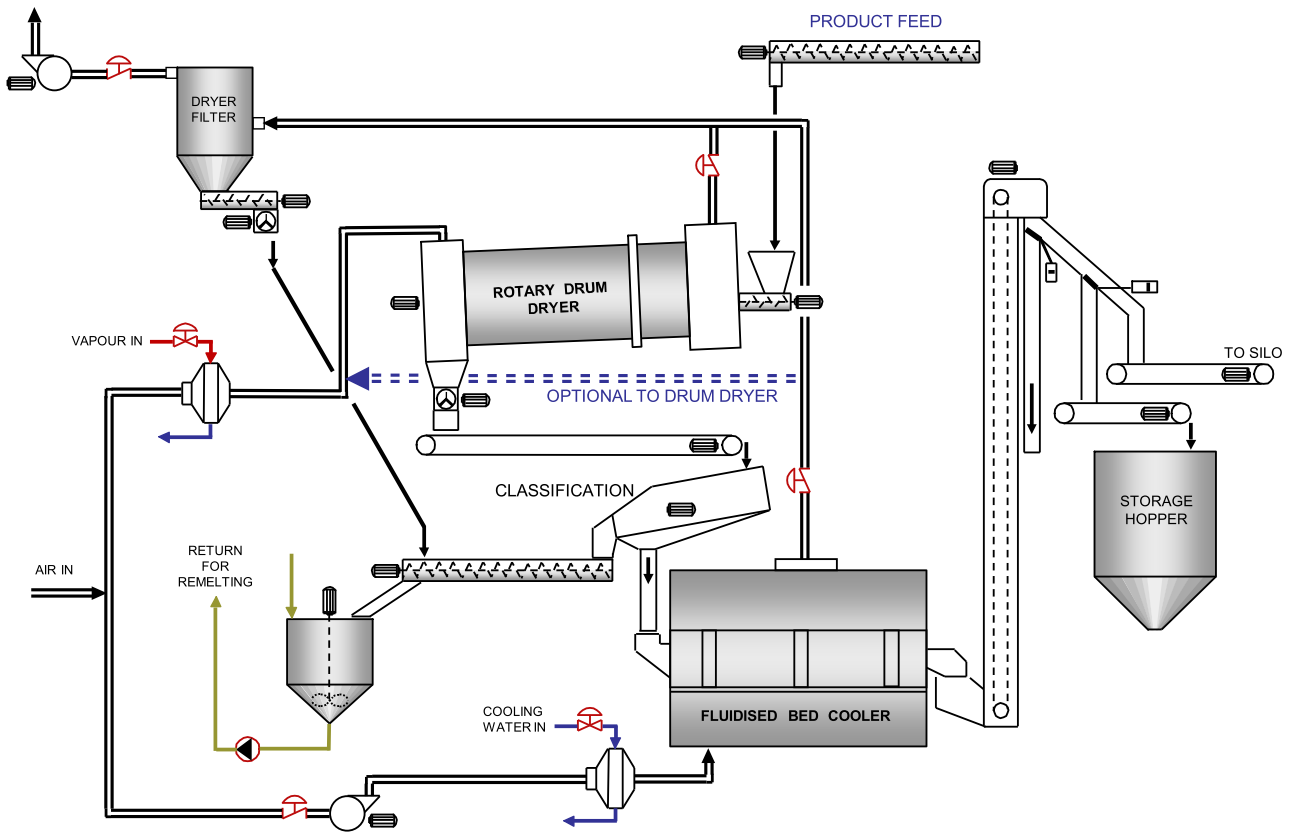
Process flow diagram of an integrated sugar drying and cooling system
Optimise your sugar drying and cooling process
Improve crystal quality and energy efficiency with an integrated drying and cooling solution tailored to your production requirements.
Sugar beet pulp drying is where our technological heritage in the sugar industry began more than a century ago. Although the basic drying principle remains unchanged, our drying technology has evolved considerably.
Processing one tonne of sugar beet produces approximately 160–170 kg of sugar and 500 kg of wet beet pulp. The wet pulp typically contains 10–15% dry matter, which can be increased to 24–27% through mechanical dewatering.
Due to its high moisture content, wet beet pulp deteriorates rapidly and is costly to transport. Thermal drying offers several advantages over storing and ensiling wet beet pulp:
Extended product shelf life.
Immediate processing after mechanical dewatering.
Reduced intermediate storage requirements.
Substantial reduction in product weight and volume.
Reduced transport and handling costs.
The co-current Rotary Drum Dryer is particularly suitable for processing the long fibres of sugar beet pulp. The dried product is free-flowing and can subsequently be pelletised for use as animal feed.
Even after mechanical dewatering, sugar beet pulp retains a considerable amount of water, making thermal drying an energy-intensive process.
Ingetecsa’s Rotary Drum Dryer incorporates specially designed internals to optimise heat transfer and product uniformity.
In the first section of the dryer, specially designed lifting plates continuously distribute the wet fibres as a curtain through the hot gas stream, ensuring intensive contact between the drying gas and the product.
In the subsequent section, specially shaped cruciform internals substantially increase the effective heat transfer area and promote uniform drying of the fibres.
Partial recirculation of the exhaust gases further reduces the thermal energy requirement of the drying process.
The combination of these design features enables efficient moisture removal while producing a uniform, free-flowing product suitable for subsequent storage and pelletising.

Controlled drying and gentle cooling promote crystal brilliance while minimising mechanical damage and water occlusion.
Optimised heat transfer, carefully controlled process conditions and exhaust gas recirculation where applicable reduce thermal energy requirements.
Robust equipment designed for the demanding operating conditions of industrial sugar production.
Drying and cooling stages engineered to complement each other, ensuring consistent product quality and efficient operation.
Equipment and process configurations tailored to production capacity, product characteristics and existing plant infrastructure.
More than a century of technological heritage in the sugar industry, combined with 60 years of Ingetecsa's experience in industrial thermal processing.
A new drying or cooling installation is not always necessary. Existing equipment can often be modified or upgraded to meet changing production requirements.
Ingetecsa has extensive experience in revamping existing thermal processing equipment, extending its operational lifetime or adapting it to new process conditions.
Depending on the condition and configuration of the existing installation, revamping may offer opportunities to:
Increase production capacity.
Improve product quality.
Reduce energy consumption.
Improve operational reliability.
Extend equipment lifetime.
Reduce capital investment by reusing existing equipment.
Each project starts with an assessment of the existing equipment and process conditions to determine the most suitable technical and economical solution.
The selection and design of the most suitable drying and cooling system depend on the product characteristics, process conditions and required final product quality.
At Ingetecsa’s test centres, pilot-scale trials can be conducted to evaluate product behaviour under different thermal processing conditions.
By combining pilot testwork, industrial references and decades of engineering experience, Ingetecsa develops process solutions with particular attention to product quality, operating costs and equipment availability.
The results provide a reliable basis for process optimisation, equipment selection and scale-up to industrial production.

Ingetecsa’s test centre for pilot-scale process trials
Discuss your sugar drying and cooling application
Whether you are planning a new installation or looking to optimise an existing sugar drying and cooling process, Ingetecsa can help you develop the most suitable technical solution.