Select your language
Select your language


Efficient drying of tapioca fibres with reduced energy
consumption and stable product quality

Tapioca fibre is generated in large quantities during starch production and typically leaves the process with very high moisture content, often around 85%. At these moisture levels, the product is difficult to store, transport and process further due to rapid deterioration and limited shelf life.
Drying significantly reduces product weight and volume while improving storage stability and enabling downstream valorisation of the fibres. Dried tapioca fibre can be used in animal feed, bio-composites, paper additives and other industrial applications.
As much of the moisture is trapped within the fibre structure itself, efficient drying requires sufficient residence time and controlled thermal exposure to achieve stable final moisture levels.
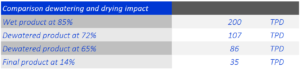
Drying significantly reduces product weight and volume while improving storage stability, transport conditions and downstream handling.
Mechanical dewatering is an effective first step to reduce the moisture content of wet tapioca fibres prior to thermal drying. Technologies such as belt presses efficiently remove surface water from the fibres, significantly reducing the evaporation load in the downstream drying stage.
Although the moisture reduction may initially appear limited, the impact on process economics is substantial due to the large reduction in product mass and thermal energy demand.
Reducing the moisture content before thermal drying lowers fuel consumption, reduces dryer size requirements and improves overall plant efficiency.
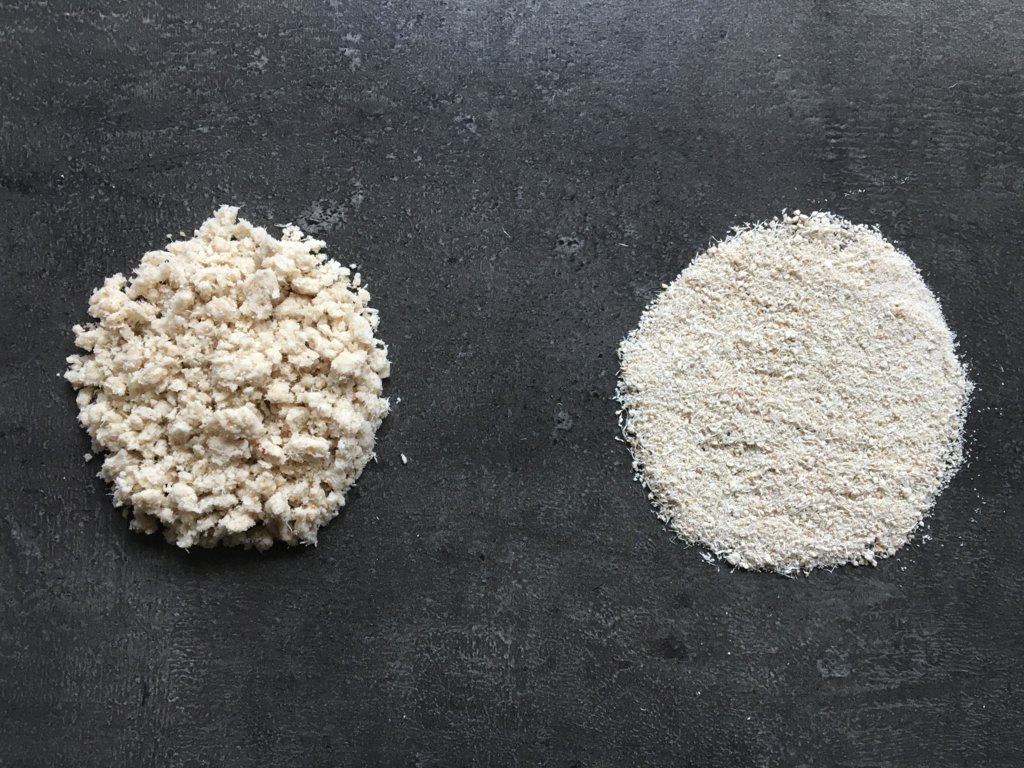
Wet tapioca fibres compared to dried product after Spiral Flash Drying
Conventional flash dryers are generally not suitable for drying tapioca fibres to low final moisture levels, as the fibres tend to foul the flash pipes while the residence time is often too short to effectively remove moisture trapped within the fibre structure.
The Spiral Flash Dryer operates with product recirculation to prevent build-up and stabilise the drying process. In addition, the unique spiral flow pattern creates highly turbulent drying conditions and significantly increases the effective drying time inside the drying chamber compared to conventional flash dryers.
This allows efficient drying of fibre materials down to typical final moisture levels of 12–14%, resulting in a stable and uniformly dried product with improved shelf life and excellent handling characteristics suitable for storage, transport and downstream applications.
The Spiral Flash Dryer itself contains no moving parts inside the drying chamber, ensuring high reliability, low maintenance requirements and excellent plant availability under continuous industrial operation.
The dried fibre product is typically discharged below 65°C, allowing direct storage or bagging without additional cooling equipment.
The Spiral Flash Dryer can operate with different heating systems depending on available plant utilities and energy strategy. Suitable heat sources include boiler exhaust gases, indirect hot air systems and biogas-fired heating solutions.
In tapioca processing plants, biogas generated on-site can be efficiently integrated as a sustainable heat source for the drying process.

Discuss your tapioca fibre drying needs
Advantages of the Spiral Flash Dryer for tapioca fibres
Suitable for high-moisture fibre drying

The spiral flow pattern creates longer and more turbulent drying conditions than conventional flash dryers, allowing efficient drying of fibres containing moisture trapped within the fibre structure.
Suitable for biogas integration
Can operate with biogas, indirect hot air systems or boiler exhaust gas heating systems.
High reliability and low maintenance
No moving parts inside the dryer ensure stable industrial operation.
Reduced product volume and improved shelf life
Drying significantly reduces product mass and volume while improving storage and transport conditions.
Controlled final moisture
Ensures stable residual moisture levels and consistent downstream product handling.
Compact and flexible installation
The self-supported design simplifies plant integration and reduces installation complexity.
Optimise your tapioca fibre drying process
Ingetecsa designs drying systems for tapioca fibres with focus on energy efficiency, stable product quality and reliable industrial operation.
Our engineers assess moisture levels, production capacity and available heat sources to determine the most suitable drying configuration for your process.