Select your language
Select your language


Efficient drying of tapioca fibre and bagasse using Ingetecsa's Spiral Flash Dryer (SFD).

Tapioca fibre, also known as tapioca bagasse, is a by-product of starch production. With an initial moisture content often around 85%, the wet fibres are difficult to store and transport and have a limited shelf life.
Drying reduces product mass and volume, improves storage stability and enables further use in animal feed, bio-composites, paper additives and other industrial applications.
Because moisture is retained within the fibre structure, effective drying requires sufficient residence time and controlled thermal exposure.
For other fibre products and drying technologies, explore our fibre drying solutions.
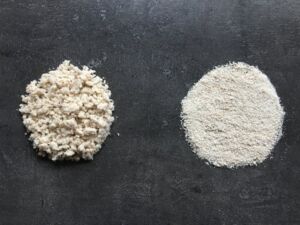
Wet tapioca fibre (left) and dried fibre (right)
Mechanical dewatering, for example using belt presses, removes part of the water before thermal drying.
Even a relatively small reduction in moisture content can substantially reduce the evaporation load, fuel consumption and required dryer capacity.
Combining mechanical dewatering with thermal drying improves the overall energy efficiency of the process.
Conventional flash dryers often struggle to achieve low final moisture levels when processing tapioca fibres. The short residence time and tendency of fibres to accumulate inside the flash pipes can limit drying performance.
Ingetecsa’s Spiral Flash Dryer uses a spiral airflow pattern and product recirculation to extend the effective drying time and maintain turbulent drying conditions.
This allows tapioca fibres to be dried to typical final moisture levels of 12–14%, producing a stable product suitable for storage, transport and further processing.
The drying chamber contains no moving parts, minimising maintenance requirements and supporting reliable continuous operation.

Optimise your tapioca fibre drying process
Discover how Ingetecsa's Spiral Flash Dryer can improve drying efficiency.
Dried tapioca fibre typically leaves the Spiral Flash Dryer below 65°C, allowing direct storage or bagging without additional – or minimal – cooling equipment.
The dryer can be integrated with different heat sources, including boiler exhaust gases, indirect hot air systems and biogas-fired heating.
Biogas produced on-site at tapioca starch plants can provide a useful energy source for the drying process.
Benefits of Ingetecsa's Spiral Flash Dryer
Effective drying of high-moisture fibres

Extended drying time and turbulent airflow support moisture removal from the fibre structure.
Consistent final moisture
Typical residual moisture levels of 12–14%.
Flexible energy integration
Compatible with biogas, boiler exhaust gases and indirect heating. And combinations are also possible.
Reliable operation
No moving parts inside the drying chamber.
Improved storage and handling
Reduced product mass and volume with improved shelf life.
Compact installation
Self-supported design simplifies plant integration.
Discuss your tapioca fibre drying application
Contact Ingetecsa to discuss your feed moisture, production capacity and available heat sources.