Select your language
Select your language


Controlled moisture reduction while preserving product quality

Deep drying is the process of reducing the moisture content of flour or starch to levels below those typically achieved by conventional drying.
During conventional drying, free moisture is removed relatively easily through evaporation. As the moisture content decreases, the remaining water becomes increasingly bound to the product, requiring more energy to remove.
This makes deep drying particularly challenging. As less water is available for evaporation, the product temperature can rise, increasing the risk of thermal degradation, discolouration and unwanted changes in product properties.
Careful control of drying temperature and residence time is therefore essential to achieve the required final moisture content while maintaining product quality.
As the moisture content of flour or starch decreases, evaporative cooling becomes less effective and the product temperature may rise rapidly. This makes temperature control particularly important during the final stage of drying.
Excessive product temperatures can cause discolouration, Maillard reactions and changes in product functionality. The risk depends on the material composition, operating temperature and residence time.
Deep drying must also be distinguished from pre-gelatinisation. The objective is to achieve the required low moisture content without unintentionally altering the starch structure or its functional properties.
Flour and starch powders also require careful consideration of combustible dust hazards. Appropriate equipment design, process controls and explosion protection measures are essential for safe operation.
Ingetecsa’s Spiral Flash Dryer (SFD) provides an effective solution for the deep drying of flour and starch. The system combines intensive contact between the product and drying air with a short residence time, allowing moisture to be removed rapidly while limiting prolonged exposure to elevated temperatures.
Unlike conventional flash dryers, the Spiral Flash Dryer uses a specially designed static drying chamber to generate a controlled swirling airflow. This promotes efficient heat and mass transfer without the need for rotating mechanical components inside the drying chamber.
As the product approaches its target moisture content, careful control of the drying conditions becomes increasingly important. The operating parameters are selected according to the characteristics of the material, the required final moisture content and the acceptable product temperature.
The absence of moving parts inside the drying chamber also reduces mechanical wear and simplifies maintenance. For combustible powders such as flour and starch, the complete installation must nevertheless be designed with appropriate dust explosion protection measures.
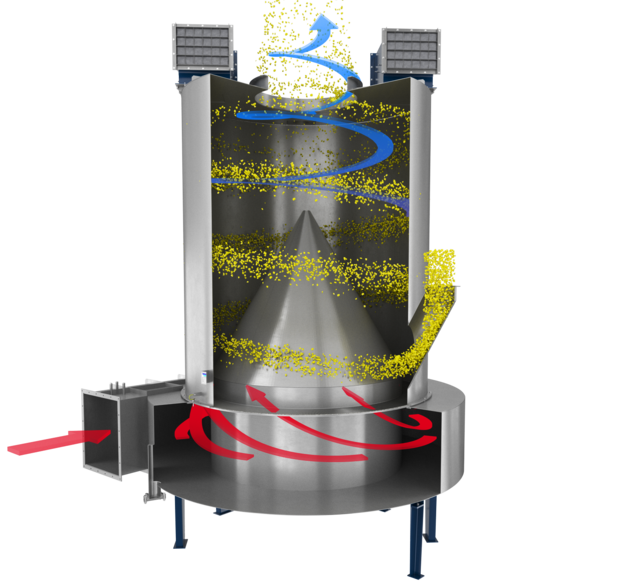
Operating principle of the Spiral Flash Dryer
Discuss your deep drying application
Advantages of the Spiral Flash Dryer
Short residence time

Rapid drying limits prolonged exposure to elevated temperatures.
Efficient heat and mass transfer
Intensive contact between product and drying air promotes efficient moisture removal.
No moving parts in the drying chamber
Improved hygiene, easier cleaning, safer, and reduced maintenance.
Controlled final moisture content
Operating conditions can be adapted to the required residual moisture and product characteristics.
Suitable for heat-sensitive products
Short exposure times help minimise unwanted thermal changes in flour and starch.
Deep drying of flour can be required when a particularly low moisture content is needed for subsequent processing or to achieve specific product characteristics. Careful control of the drying conditions helps minimise discolouration and unwanted changes in functionality.
Starch can be dried to low residual moisture levels for specialised industrial applications. The drying process must be carefully controlled to avoid unintended gelatinisation or thermal degradation, depending on the starch type and required product properties.
Deep drying can also be an important preparation step before dextrinisation. Reducing the moisture content before thermal treatment helps establish the required conditions for the subsequent conversion process. The target moisture content and drying conditions depend on the starch and the intended dextrin properties.
The deep drying behaviour of flour and starch depends on the raw material, initial moisture content and required final product properties. Pilot testing helps establish suitable operating conditions before proceeding to commercial-scale equipment design.
At Ingetecsa’s test centre, drying trials can be used to evaluate moisture reduction, product temperature and material behaviour under representative process conditions.
The results provide a basis for selecting the appropriate drying parameters and developing a suitable industrial drying solution.
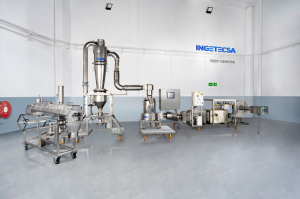
Ingetecsa Test Centre – pilot drying installation
Optimise your deep drying process
Ingetecsa develops industrial drying solutions for flour and starch applications requiring low residual moisture levels. Our engineers evaluate product characteristics, target moisture content and process conditions to determine the most suitable drying configuration. Pilot testing at our Test Centre helps establish the operating parameters for reliable commercial-scale operation.