Select your language
Select your language


Ingetecsa has decades of experience in the design and supply of industrial drying and cooling equipment for native and modified starches, with references worldwide.
Our technologies include conventional flash drying, Spiral Flash Drying, flash cooling, paddle drying and drum drying. This page provides an overview of starch processing and the technical principles behind these technologies, including developments aimed at improving product quality, energy efficiency and hygienic operation.
Starch, also known as amylum, is a carbohydrate (polysaccharide) found in tubers such as potatoes and cassava, cereals such as maize, wheat and rice, and a wide range of pulses, fruits and vegetables. Starch is extracted from more than 50 plant species, each producing granules with characteristic sizes, shapes and properties.
Starch is widely used in the food industry as a thickening and stabilising agent, providing viscosity, texture, mouthfeel and consistency. Its applications also extend to numerous non-food industries.
The extraction process depends on the plant source. For tubers, starch is released by breaking open the plant cells, while cereals are generally processed through wet milling. Extraction also produces valuable by-products, including fibres and proteins, which are separated for further use.
Following extraction, the starch slurry is mechanically dewatered, typically using a centrifuge or filter press. The resulting wet starch cake is then thermally dried to produce native starch, retaining its original functional properties.
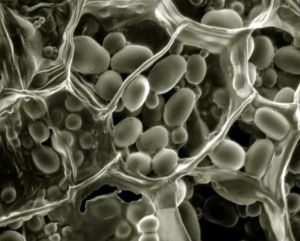
Conventional flash drying remains a widely used technology for drying mechanically dewatered starch cake. Flash dryers can handle high throughputs and evaporate large quantities of water while maintaining relatively low product temperatures, helping to preserve the functional properties of the starch.
A conventional flash drying system consists of five main components:
The drying process must be carefully controlled to avoid excessive product temperatures, which could alter the functional properties of the starch.

In most conventional flash dryers, the top bend is a simple curved duct connecting the upward and downward sections of the drying pipe. Its main purpose is to reverse the direction of the starch flow and provide additional drying time.
However, as the starch particles accelerate through the flash drying pipe, their velocity approaches that of the hot drying air. The reduced relative velocity between the air and the particles limits convective heat transfer and reduces drying efficiency.
The Ingetecsa top bend has been specifically designed to overcome this limitation. Rather than providing a smooth change in direction, its geometry creates turbulence and changes the relative velocities and directions of the air and starch particles.
This design improves heat and mass transfer, increases the rate of moisture evaporation and helps maintain a lower starch temperature during drying.
Compared with a conventional smooth top bend, the Ingetecsa design can therefore achieve lower product temperatures and reduced energy consumption. These effects can be demonstrated in our test units.
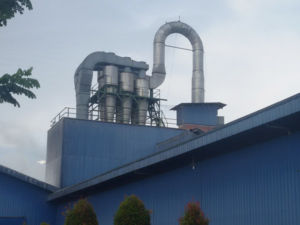
Conventional smooth top bend, shown for
comparison with the Ingetecsa design
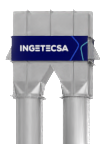 Ingetecsa top box design
The eccentric feeder is an important component of conventional starch flash dryers. It is also known in the industry as a sling, atomiser, cascade feeder or centrifugal feeder.
Its operation requires careful adjustment by experienced operators to ensure consistent feeding of the wet starch cake into the drying system. Conventional eccentric feeders also require regular cleaning and maintenance.
Over the years, Ingetecsa has continuously improved its eccentric feeder design. These developments have resulted in more compact equipment and substantially reduced electrical power consumption.
In food-grade starch applications, many of our eccentric feeders require cleaning only two or three times per year, with routine maintenance typically limited to an annual service.
Ingetecsa introduced the Spiral Flash Dryer towards the end of the last century. Following several years of successful operation and positive customer feedback, it became our standard technology for drying native starch.
Unlike conventional flash dryers, the Spiral Flash Dryer does not require an eccentric feeder. Instead, the high air velocities within the dryer break up the mechanically dewatered starch cake, eliminating the need for moving parts in the drying zone.
This entirely static design offers several advantages, including improved hygiene, reduced maintenance requirements and more consistent product quality.
Operational experience has shown that starch leaving a Spiral Flash Dryer is typically 2–3°C cooler than starch dried in a conventional flash dryer. The absence of an eccentric feeder also eliminates a potential source of product accumulation and the associated risk of burnt particles.
The Spiral Flash Dryer can also be combined with heat recovery technology to reduce steam consumption.
For a detailed explanation of the operating principle, technical advantages and industrial applications, visit our dedicated Spiral Flash Dryer for starch drying page.

Following drying, starch is often cooled before being conveyed to storage silos or packing lines. Ingetecsa’s Flash Cooler combines these two operations in a single pneumatic system, cooling the dried starch while transporting it to its next destination.
The dried starch is discharged from the dryer cyclones through rotary valves directly into the cooling duct. Cooling air picks up the fine starch particles and conveys them through the system, reducing the product temperature to close to ambient conditions.
Depending on the installation layout, conveying distances of up to approximately 200 metres are possible, including horizontal and vertical sections. This allows the starch to be transferred between buildings or elevated for gravity feeding into downstream equipment.
For more information on the operating principle and technical advantages, visit our dedicated Starch cooling page.

Ingetecsa 300 TPD tapioca starch drying installation with Spiral Flash Dryer and Flash Cooler
Thermal energy consumption is an important operating cost in industrial starch drying, particularly in installations using steam-heated drying air.
Ingetecsa has developed a three-stage heat recovery system that recovers thermal energy from the drying process and reuses it to reduce the demand for fresh steam.
Depending on the operating conditions and system configuration, steam consumption can be reduced by up to 28%. This makes heat recovery particularly attractive for large-capacity starch drying installations, where even relatively small improvements in thermal efficiency can result in substantial annual energy savings.
For further information on the operating principle, technical requirements and potential savings, visit our dedicated Heat recovery for starch drying page.
Starch can be modified to change its functional properties and extend its range of applications. Modification can be achieved through thermal, chemical or enzymatic treatment.
One important form of thermal modification is pregelatinisation. When starch is heated in the presence of sufficient water, its granules swell and lose their original crystalline structure. Subsequent drying produces pregelatinised starch.
Unlike native starch, pregelatinised starch can develop viscosity in cold water without requiring further cooking. This makes it particularly suitable for applications where instant thickening or binding properties are required, such as sauces, soups and other prepared foods.
Pregelatinised starch also has applications outside the food industry. Its final properties depend on the original starch source and the conditions used during modification and drying.
A single drum dryer can be used to produce pregelatinised starch from a homogeneous slurry of starch and water.
The slurry is pumped onto the surface of a heated rotating drum, where it is heated above the gelatinisation temperature. Applicator rolls and scraper knives positioned above the drum ensure thorough mixing and sufficient residence time, allowing an almost complete degree of gelatinisation.
As the drum rotates, moisture evaporates and the gelatinised starch forms a thin, dry film on its surface. This film is removed by a scraper blade and subsequently milled to the required particle size.
The resulting pregelatinised starch can be easily dosed into final blends and applications without requiring further cooking.

Discuss your starch processing requirements
Whether you are developing a new starch processing plant, upgrading an existing drying system or investigating opportunities to improve energy efficiency, Ingetecsa can support you with process expertise and equipment selection. Our experience covers conventional flash drying, Spiral Flash Drying, starch cooling and the production of pregelatinised starch. Contact our engineers to discuss your process requirements, operating conditions and potential equipment solutions.